Showing posts with label Inovation. Show all posts

Is medical hypnosis effective?


Is medical hypnosis effective? - On the mornings she undergoes chemotherapy, Jeanne Safer hypnotizes herself en route in the taxi.

She starts by closing her eyes, then rolling them up to the top of her head and down, all the while breathing deeply. "As I'm doing that, I'm saying to myself, 'This is a procedure that will save my life. I'm not going to fight it. I'm going to make it as easy on my body as possible,' " she said.

Safer, a New York psychologist who has a rare but curable form of leukemia, started out as a skeptic, but found that hypnosis helped put her at ease before biopsies, MRIs and several surgeries. She now uses it with some of her patients as well. "It's an excellent self-management technique," she said. "It gives me a feeling of mastery, a sense that I am participating in my own care rather than just being passive."

Hypnosis has been the subject of fascination, intrigue and ridicule for centuries. Now, researchers are getting closer to understanding why and how it can work. The mechanism may be similar to the placebo effect—in which patients' expectations play a major role in how they feel. Hypnosis, in turn, can help patients adjust those expectations to minimize pain, fear and disability.


http://media.washtimes.com/media/community/viewpoint/entry/2012/05/21/iStock_000018796402Small_selimaksan_s640x426.jpg?d9df90bc03b78ac13713e2120229f166a08c6acb


The image of a stage hypnotist swinging a stopwatch and commanding a volunteer to squawk like a chicken has led to misunderstandings, experts say. Real hypnosis for therapeutic purposes gives subjects more control over their minds and bodies, not less.

"We can teach people how to manage pain and anxiety, " said Dr. David Spiegel, a psychiatrist and director of the Center for Health and Stress at Stanford University who has studied hypnosis for 40 years. "There's been this mistake in medicine that if you have a certain amount of tissue damage, you should feel this amount of pain. But many things can alter how much pain you feel."

Indeed, scientific evidence is mounting that hypnosis can be effective in a variety of medical situations, from easing migraine headaches to lowering blood pressure, controlling asthma attacks, minimizing hot flashes and diminishing side effects from chemotherapy.

Last week, two studies from Sweden found that one hour a week of hypnotherapy for 12 weeks eased symptoms of irritable-bowel syndrome in 40 percent of patients (compared with 12 percent in a control group) and that the positive effects can last as long as seven years.

Such scientific findings still catch skeptics by surprise—in part because many claims haven't been carefully studied. "Hypnosis is like a good kid with a bad reputation. Everybody is interested, but in the back of their minds, they're thinking of Bela Lugosi," said Dr. Guy Montgomery, director of the Integrative Behavioral Medicine program at Mount Sinai Medical Center in New York who has led many of the studies. "It's not mind control. We can't make somebody rob a bank," he says.

Hypnotherapy does typically begin with the therapist instructing patients to relax deeply—often with long, slow breaths—then focus their attention intently. Some versions have patients imagine being on a beach or in another pleasant setting and enjoying all the sights, sounds and sensations.

Once patients are relaxed and focused, practitioners give them soothing messages and suggestions, such as, "You have no urge to smoke" or "There is nothing to fear." Theoretically, those thoughts remain even after the patient is focusing on the real world again.

However it works, a hypnotic suggestion in the mind can have measurable effects in the body.

One Stanford study asked subjects to imagine that they were eating, and their secretions of gastric acid increased by 70 percent. In a study from Harvard Medical School published in the Lancet in 2000, patients who had 15 minutes of hypnosis before surgery not only needed less pain medication afterward, but also took less time in surgery, saving an average of $331 each.

"There is a strong link to physiology—and it's getting stronger, the more research is being done," said Tanya Edwards, director of the Center for Integrative Medicine at the Cleveland Clinic. She said about half of the center's patients are referred by other Cleveland Clinic physicians, particularly gastroenterologists, oncologists and primary-care physicians looking for ways to help reduce patients' pain.

Brain-imaging studies have shown that while parts of the brain that register painful sensations are still active, the anterior cingulate cortex, which reflects attention, is less engaged. That observed brain effect is greater in the 10 percent to 15 percent people who are "highly suggestible" to hypnosis. About 30 percent of people are resistant—particularly those who are deeply skeptical.

Whether patients are actually in a "trance" is a matter of debate. Montgomery said the notion is upsetting to some people, and he finds that being relaxed and at ease is sufficient to benefit.

Spiegel counters that "you get more bang for your buck if you're in a trance," which he describes as being completely absorbed—like being engrossed in a great book or movie. But he notes that people can enter and exit that state at will.

Experts say there are few harmful side effects to hypnosis, although some hypnotists who claim to help clients "recover" lost memories have been charged with implanting false ones, which can be highly destructive to real relationships.

Finding a hypnotherapy practitioner can be confusing. There are no state regulations for lay practitioners, and the term "certified hypnotherapist" has little meaning, since some groups that issue certificates have very lax standards. (Psychologist Steve E. Eichel caused a stir in 2002 by obtaining hypnotherapist credentials for his cat, Dr. Zoe D. Katze, from several associations.)

Seeking help from a medical or mental-health professional who has a state license in that field and offers hypnosis along with other services is a safer choice, many experts say. Any medical or psychological issues should be fully evaluated before a patient tries hypnosis. ( The Wall Street Journal )

Blog : Luxurious | Is medical hypnosis effective?

READ MORE - Is medical hypnosis effective?

Chinese craze for English tattoos


Chinese craze for English tattoos - Tattoos of Chinese characters have long been a fad in the West as a way of denoting the mystique of their bearers.

But in a reversal of the trend, Chinese ink parlours are reporting a sudden craze among their clients for tattoos in English.

Zhang Aiping, a tattooist at Tattoo 108 in Shanghai, said: "Around 30 per cent to 40 per cent of our customers are choosing tattoos in English letters now. This has happened really suddenly, since the beginning of this year.


http://i.telegraph.co.uk/multimedia/archive/01386/tattoo_1386361c.jpg
Chinese ink parlours are reporting a sudden craze among their clients for tattoos in English


"I just did one a few days ago for a footballer at Shanghai Shenhua club. It said: 'I miss u forever'."

Tattoos have existed in China for thousands of years, but have been largely taboo under Communist Party rule.

Only in the last five years have scores of tattoo parlours sprung up, operating in a grey zone of legality.

Chinese clients have been inspired by footballers such as David Beckham and American basketball stars.

Mr Beckham sports a tattoo in Chinese characters, inked on a trip to Hong Kong, which reads: "Death and life have determined appointments. Riches and honour depend on heaven".

Others have been less felicitous with their choice of Chinese words, with combinations that leave native speakers scratching their heads.

One Chinese tattooist said he had seen a Westerner with the character meaning "gas" on his arm, instead of "spirit".

Marcus Camby, a basketball player for the Los Angeles Clippers, has two enormous characters on his upper arm with no obvious meaning in Chinese.

In China, meanwhile, the motivation for choosing English letters is simple – any foreign language is mysterious and exotic.

At Tattoo 007, Zhu Jian has inked a variety of English phrases, some more grammatically correct than others, including "Mr Lonely", "Best love in my life" and "I belong to the god and it bless me".

He founded his parlour in 2002, in a residential building in a central Shanghai suburb.

"We get 20 to 30 customers a month, and import our paint and needles from Europe," said Mr Zhu, who charges an average of 1000 yuan (£100) per tattoo, the equivalent of a factory worker's monthly salary.

"We get mostly college students, but we have also had doctors, professors and bankers. Tattoos of letters have become very popular since last year, with around three out of ten people going for them. They are simple and graceful," he said. "Quite a few just copy the tattoo of their favourite stars, like Beckham or Angelina Jolie."

Yang Enna, a 22-year-old television producer in Shanghai, said: "English tattoos are just more special. They are very trendy and they say something about my personality.

"They are much simpler compared to Chinese characters and can hold deep meanings. English letters can be used as acronyms so your privacy is protected and people are curious about what you have written on your arms.

"If I had tattoos in Chinese, everyone would immediately know what they meant," she said. ( telegraph.co.uk )

READ MORE - Chinese craze for English tattoos

Doomsday shelters line Kansas missile silo


Doomsday shelters line Kansas missile silo - Tucked deep beneath the Kansas prairie, luxury condos are being built into the shaft of an abandoned missile silo to service anxious -- and wealthy -- people preparing for doomsday.

So far, four buyers have plopped down a total of about $7 million for havens to flee to when disaster happens or the end is nigh. And developer Larry Hall has options to retro-fit three more Cold War-era silos when this one fills up.


http://l.yimg.com/bt/api/res/1.2/mCI9CpBuAB6SWLWrzsG9Sg--/YXBwaWQ9eW5ld3M7Zmk9aW5zZXQ7aD0zMDI7cT04NTt3PTUxMg--/http://media.zenfs.com/en_us/News/afp.com/TRWas6357137.jpg
A sign on a country road points the way to a site where survival condos are being built in a former nuclear missile silo north of Salina, Kansas. So far, four buyers have plopped down a total of about $7 million for havens to flee to when disaster happens or the end is nigh. (AFP Photo/Joe Lambe)


"They worry about events ranging from solar flares, to economic collapse, to pandemics to terrorism to food shortages," Hall told AFP on a tour of the site.

These "doomsday preppers", as they are called, want a safe place and he will be there with them because Hall, 55, bought one of the condos for himself. He says his fear is that sun flares could wipe out the power grid and cause chaos.

He and his wife and son live in Denver and will use their condo mostly as a vacation home, he says, but if the grid goes, they will be ready.

Hall isn't the first person to buy an abandoned nuclear missile silo and transform at least part of it into a shelter.

Built to withstand an atomic blast, even the most paranoid can find comfort inside concrete walls that are nine feet thick and stretch 174 feet (53 meters) underground.

Instead of simply setting up shop in the old living quarters provided for missile operators, Hall is building condos right up the missile shaft. Seven of the 14 underground floors will be condo space selling for $2 million a floor or $1 million a half floor. Three and a half units have been sold, two contracts are pending and only two more full units are available, Hall said.

For now, metal stairs stretch down to connect each floor but an elevator will later replace them. The units are within a steel and concrete core inside the original thick concrete, which makes them better able to withstand earthquakes.

He is also installing an indoor farm to grow enough fish and vegetables to feed 70 people for as long as they need to stay inside and also stockpiling enough dry goods to feed them for five years.

The top floor and an outside building above it will be for elaborate security. Other floors will be for a pool, a movie theater and a library, and when in lockdown mode there will be floors for a medical center and a school.

Complex life support systems provide energy supplies from sources of conventional power, as well as windmill power and generators. Giant underground water tanks will hold water pre-filtered through carbon and sand.

And, of course, an elaborate security system and staff will keep marauding hordes out.

The condo elevator will only operate if a person's fingerprint matches its system, Hall said. Cameras will monitor a barbed-wire topped fence and give plenty of warning of possible intruders. Responses can range from a warning to lethal force.

"If they try to climb the fence we can stun them," he said. "If they want to break into the system, we can put an end to that."

Doomsday fears have flourished throughout history, but what once involved isolated pockets of fear now spreads worldwide through the media and Internet.

They have also expanded into the popular culture thanks to the success of dystopian fantasies like the Hunger Games and a National Geographic reality show about those preparing for doomsday.

"Fear sells even better than sex," said John Hoopes, a professor in the anthropology department at the University of Kansas who has studied the spread of doomsday culture.

"Now the entire planet is involved and that's the result of the Internet," he said.

"I think it's mostly a strategy for feeling less alone and helpless," he said. "People don't like to feel they're the only ones fearing the inevitable, which is each individual's personal death."

Those who sign on to prepare for the worst, he said, fall into a salesman's strategy: "Act now, or you're a loser."

Hall says threats from nature and man are increasing and he wants to create a safe communal society where people survive chaos in comfort, with each person doing an assigned job and interacting with others.

A tombstone-shaped sign declaring "This Old Missile Base" leads to a locked fence surrounding the construction site northwest of Salina. Hall insists the exact location be kept secret.

The fence slides open and Hall leads reporters or potential buyers past an opening in the ground to the metal stairs stretching down the silo.

"You can stand here and literally it's like a deprivation chamber -- you can't hear anything," Hall said pointing out the 10-foot high ceilings and a cave-like quiet.

He is working to finish an 1,800 square-foot (167 square-meter) unit for a wealthy businesswoman with two teen children.

Electronic screens will serve as windows, offering views of Paris, New York, a beach, a forest or whatever she decides to see.

The unit itself will have top-end appliances, walk-in closets in the bedrooms, a kitchen and dining area and two living rooms to avoid arguments about what to watch on TV.

So far he has spent $4 million on the entire silo, including $300,000 he paid for it in 2008, when it was flooded with water and locked by giant steel doors. He expects to have all the seven floors of condos sold by August.

Interested buyers have included an NFL player, a racing car driver, a movie producer and famous politicians, he said, but he now requires all the money up front.

Four people who put down $250,000 deposits could not come up with the rest and he returned the deposits, but the economy is getting better and global warming, strange weather and disasters are stoking fears.

The recent earthquakes in Mexico prompted several calls from potential buyers, he said, predicting more bad things will happen and more silos will be waiting.

About 70 Atlas-F silos were built and he has options on three more of them, he said.

"One is an entire silo for one individual, but I won't know that until his check clears the bank," Hall said. ( AFP )

READ MORE - Doomsday shelters line Kansas missile silo

Tips for Staying Productive While Working From Home


Tips for Staying Productive While Working From Home - Perhaps you tried working from home because it was your dream to cozy up on your couch and do your work without changing out of your pajamas. But if you’ve found that you get distracted by household chores, or you find yourself doing laundry instead of completing your assignment for the day, here are some tips to make working from home more effective:


http://a57.foxnews.com/img.foxnews.com/static/managed/img/fb/Sbc/entrepreneurs/660/371/Netbook-Laptop-Woman-Phone-Computer-Lap-Cafe.jpg


Remain professional.

It's hard to be taken seriously by co-workers or a potential client if they can hear your dog barking or a baby crying in the background.

Avoid using your house phone for business purposes and stick to your cell phone or a separate business line instead--you don’t want your toddler to beat you to the phone when an important call comes in. Make sure your answering machine is clear and without background noise.

Even if you stay at home all day, dress as if you are going to the office to help remind you that it is time for working, not napping.

Minimize distractions.

Lisa Kanarek, home office expert and book author, says one of the biggest mistakes home workers make is that they don’t make it clear to others that they are actually working.

“Family and friends assume that if you’re working from home, you have time to wait for the FedEx delivery person or the washer repair person,” she says.

If your family happens to be home before you finish work, make sure they understand that you are still punched in. Do your best to prevent distractions. Close your Facebook tab. Turn off the TV. Limit your kitchen trips. If you do decide a change of scenery is in order, take your work to a quiet location so you don’t continue to get sidetracked.

Set a schedule and make goals for yourself. ApartmentTherapy.com suggests using that chunk of time that you would have spent commuting to the office to get things done.

Designate your office as a work-only space. Get off the couch and try to work at a desk.

Make sure your office is clutter-free and comfortable, but not so comfortable that you find yourself dozing off in your computer chair. Keep it clean so you can stay more focused and organized.

Do your best to actually take a lunch break and step away from your desk. This will give your brain a much-needed break and get you away from your computer screen.

Balance.

One of the perks of working from home is that you don’t have to miss your child’s soccer games because you are tied up at the office. On the flip side, working from home may also encourage your workaholic tendencies. Stop for the day so you can spend time with your family. Because you do have some flexibility, schedule lunch dates or outings with your family during the standard 9-to-5 work day. ( NewsCore )

READ MORE - Tips for Staying Productive While Working From Home

Bamboo bicycle business shoots up in a struggling African country


http://www.csmonitor.com/var/ezflow_site/storage/images/media/images/1017zambikesblogpost/10834979-1-eng-US/1017Zambikesblogpost_full_600.jpg
Zambikes manufactures, assembles, and distributes high-quality bicycles – including bikes whose frames are made from local bamboo plants – in the southern African country of Zambia. The bicycles are distributed to medical workers, pastors, or teachers allowing them to travel three times as fast as on foot.


Bamboo bicycle business shoots up in a struggling African country - Based in Zambia, Zambikes employs and empowers Africans to manufacture bicycles locally, including some made from bamboo.


Zambikes has been helping Africans get around on locally made bikes since 2007.

Now they want to get the rest of the world rolling, too, but with a twist: These new cycles are almost 100 percent bamboo.

Zambia, where Zambikes is based, ranks a staggeringly low 150 out of 169 on the UNDP’s Human Development Index. Vaughn Spethmann and Dustin McBride witnessed the country’s dire economic straits and high unemployment rate first-hand during a 2004 university trip and founded Zambikes upon their return to the United States, according to The American.

Believing business to be the best way to remedy the country’s woes, they wanted their new company to “employ and empower the uneducated and underprivileged,” Mr. Spethmann told Social Capital Markets Europe.

Spethmann says that as of May 2011, "Zambikes has distributed more than 8,000 bicycles, 900 bicycle ambulances and cargo carts, supplied much-needed spare parts, sold upwards of 200 bamboo bicycle frames worldwide, and have employed more than 100 Zambians."

Zambians who use the cargo cart can increase daily earning from $2 a day to $20, he said.

Zambikes wants to expand overseas, and it plans to do so sustainably. In addition to the metal bikes they produce in Africa, they now export bamboo bicycles to the United States.

Bamboo is exceedingly easy to grow and can shoot up two inches an hour under the right conditions, according to PlanetGreen.com. It’s flexible and light, and the bikes made from it can be put together using basic tools and machinery, according to the BBC.

Some might question the structural integrity of a bamboo bicycle, but the bikes’ proponents say they’re just as sturdy as the traditional metal frames. The Guardian’s GreenLiving Blog took one of Calfee’s bamboo models out for a spin in 2009 and found that it was comfortable, with great shock absorption. If you need to see it to believe it, check out this video of three large men piling onto a bamboo bike made in Ghana.

Zambikes isn’t the only company getting in on the action, though. Bamboosero and the Bamboo Bike Project are also trying to help Africans ride to economic prosperity. Now those in the market for a shiny new cycle can get a killer set of wheels and help support African entrepreneurs, too. ( csmonitor.com )

READ MORE - Bamboo bicycle business shoots up in a struggling African country

Luxury Bamboo Bedding Announces the Launch of its New Online Store Specializing in Luxury Bamboo Bedding, Bamboo Towels and Bamboo Bathrobes


Luxury Bamboo Bedding Announces the Launch of its New Online Store Specializing in Luxury Bamboo Bedding, Bamboo Towels and Bamboo Bathrobes. - luxurybamboobedding.com today announced the launch of their new online bamboo bedding store specializing in premium bamboo bedding, bamboo towels and bamboo robes. The store is accessible at http://www.luxurybamboobedding.com and offers luxury bamboo bedding and bath items at affordable prices.

Van William Shron, the president of Luxury Bamboo Bedding and Luxury Soft Bedding commented, “Our bamboo sheet sets and bamboo duvet covers are made from 100% bamboo fiber and are remarkably comfortable. Once you have experienced the pure silky soft comfort of bamboo bedding, you will not want to sleep on anything else. There is no finer bedding to enhance your sleep experience. Take advantage of our introductory “30% Off” premium bamboo sheet set promotion.”

The textile professionals at Luxury Bamboo Bedding got it right. Their high quality bamboo bed linens and towels (and bamboo robes) have taken bamboo bedding and bath to the next level and made some inherently good products better.


http://t1.gstatic.com/images?q=tbn:ANd9GcSQQrQ9_ajdhLr5mooX_0QwFYiBz1eSeh855Eb0YJ-tIFu9_EOdnA


Luxury Bamboo Bedding’s sheet sets, duvet covers and pillow cases have been developed over a period of eight years and are finely crafted in an ultra-fine sateen weave to enhance the natural smoothness, luster and softness that characterizes bamboo fabric. The extraordinary comfort of the bamboo bedding is enhanced by its natural strong ability to wick moisture away from the body, keeping you dry and comfortable while sleeping. Shron commented “Our new additions - bamboo towels, bamboo robes and bamboo blankets - are magnificent”.

People with sensitive skin will appreciate that Luxury Bamboo Bedding’s bamboo fabrics are remarkably smooth, non-abrasive and hypo-allergenic.

At a time when it is important to make sound ecological choices, the positive eco-narrative of bamboo is an added feature of this fine 100% bamboo bedding.

Luxury Bamboo Bedding’s new product line:

320 count bamboo sheet sets (flat sheet, fitted sheet and two pillow cases) available in queen, king, Cal king and double in five décor friendly colours: white, ivory, silver, chocolate and sage.

Premium 350 thread count bamboo sheet sets in white and ivory decorated with an elegant eyelet hem stitch.

Bamboo duvet cover sets including two bamboo pillow cases in queen or king in all five colours.

Standard and king bamboo pillow cases as separates.

Insulating bamboo blankets in queen, king and double sizes (ivory only).

Soft and luxurious bamboo towels and bamboo bath sheets in eight designer shades.

Plush bathrobes inspired by the best luxury hotel robes in white and chocolate.

Visit our new online store at luxurybamboobedding.com to see how our beautiful bamboo bedding and bamboo towels will complement your home and life style.

Quote:


The president of the company, Van William Shron, said “Considering that your sleep environment is an important personal retreat where you will spend almost a third of your lifetime, it should be an oasis of comfort to recharge and restore your life energy. You are going to love the comfort and quality of our bamboo bedding and bath products. Pamper yourself. You deserve it.” ( prweb.com )

About luxurybamboobedding.com

READ MORE - Luxury Bamboo Bedding Announces the Launch of its New Online Store Specializing in Luxury Bamboo Bedding, Bamboo Towels and Bamboo Bathrobes

Bamboo building bonanza in Bali


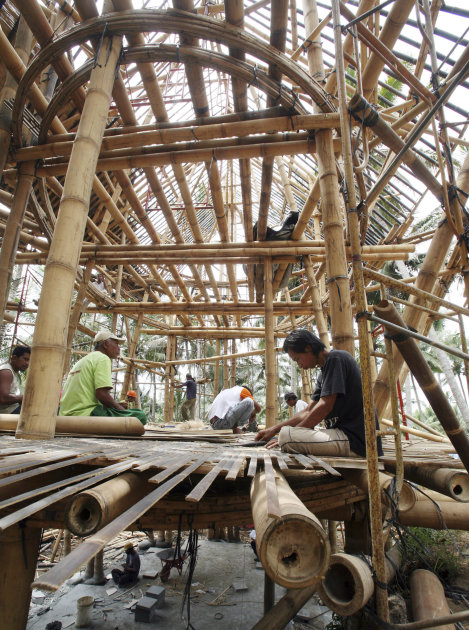
Bamboo building bonanza in Bali — Off Bali's beaten track, past a towering banyan tree and next to an ancient Hindu temple, the world's largest bamboo commercial structure is slowly taking shape: a chocolate factory.

The three-story, 23,000-square-foot building — made from more than 3,000 long, flexible poles — is crowned with a graceful, sloped ceiling nearly 50 feet high.

Frederick Schilling, co-owner of the Big Tree Farms factory, calls it his "bamboo cathedral."

The tropical plant, favored in the West for flooring, furniture and household accessories, is increasingly being touted as the construction material of choice by green advocates from South America to Africa.

Bali is leading the charge, attracting carpenters, architects and designers from across the globe to use bamboo in building everything from a school and luxury villas to exclusive resorts.

The plant, found in almost every equatorial nation, can grow up to 4 feet in a single day, reaching the height of a giant oak in less than six months. Some species are strong enough to be used for construction in five years.


http://l3.yimg.com/bt/api/res/1.2/E9Oo5S1vQgmTOuYrkwUsZA--/YXBwaWQ9eW5ld3M7Zmk9aW5zZXQ7aD02MzA7cT04NTt3PTQ2OQ--/http://media.zenfs.com/en_us/News/ap_webfeeds/196ac1438e183f18fd0e6a70670092ee.jpg
In this Oct. 6, 2011 photo, Indonesian workers construct a house entirely from bamboo at Green Village in Bali, Indonesia. Bamboo, a tough, flexible plant which can grow up to four feet a day, is being used to build everything from schools and luxury villas to exclusive resorts. (AP Photo/Firdia Lisnawati)


Cheap — costing just $3 to plant and maintain one piece until it's ready to go — tough as concrete, with the ability to bend, and incredibly abundant, the possibilities are almost limitless.

"Bamboo is definitely regarded as one of the most sustainable building materials in the world," said Schilling, whose factory is scheduled to start pumping out four to six varieties of rich organic chocolate bars in January.

"As a bonus, it's also very beautiful to work with."

Bali's craze, bringing together entrepreneurial expats and local craftsmen, started six years ago with the founding of a local bamboo production company for the construction of Green School, an exclusive international school with 275 students.

Since then, more than a dozen projects have sprung up across the so-called "island of the Gods."

Green Village, a collection of designer villas with individual price tags as high as $750,000, sits down the Ayung River from Green School. Fivelements, a holistic healing retreat, is just a few miles north.

Working with the plant requires a huge shift in the way designers think.

"We're really comfortable in our culture and in architecture with straight lines," said Elora Hardy, the creative director at Green Village. "And bamboo is not a straight line."

Some poles start in the earth and rise three floors.

In both plans and building, "we have to really keep in mind the curve ... where it's going to end up at the top."

That's exciting and "infinitely complicated," Hardy said.

Ben Ripple, Schilling's partner and the founder of Big Tree Farms, which makes spices, salts and other artisanal products sold at gourmet food stores such as Dean & DeLuca, said Bali is a "microcosm" for the art.

"What you get is a situation where five years on Bali shows what happens over a 20-year-plus period in other more developed areas."

But whether the success of bamboo here can be replicated in cooler, dry climates remains to be seen.

Strict building codes in Europe and the United States make large-scale construction projects more difficult to take on, said Victor van Praag, co-owner of PT Green Home, a bamboo design company.

Like any new industry, bamboo construction remains in a constant state of innovation, he added. The absence of well-defined standards allows for unrestrained creativity: from developing longer-lasting treatments to experimenting with design. But it also leaves room for unexpected problems.

Gove DePuy, a sustainability planner who has lived and worked in Bali full-time since 2004, said bamboo construction as it exists on the resort island was too young to be a viable option in the West.

"When you manufacture bamboo into a product, it can be tested. It can be given certifications," he said, using flooring as an example. "But if you're just picking bamboo, cutting it down and putting it up, you've left the certification to nature."

Gove rejects the idea of bamboo becoming a worldwide super material. He said its large-scale use should be limited to tropical regions where the plant's abundance, affordability and proven strengths make it most practical.

Bamboo construction has also gotten attention in Columbia, Vietnam and China, the world's leader in bamboo production.

But as green-minded expats have learned in Indonesia, their enthusiasm for bamboo is rarely matched by local people, who often view the material as second rate.

"Indonesians only think that bamboo is used for scaffolding," said Effan Adhiwira, an architect who worked on both Green School and Green Village.

Overcoming that stigma remains a challenge for Adhiwira.

Earlier this year, he opened his own architecture studio in Jakarta, Indonesia's bustling capital, where concrete and steel dominate the urban landscape. He hopes to spread the message of bamboo — and ensure its future as one of the world's leading green materials — by hosting university and community workshops across the country.

As Ripple and Schilling see it, their chocolate factory is simply one of the newest and biggest examples of the plant's untapped potential.

"Bamboo has been there in front of our noses all along," Ripple said. "This is not a revolution. It is an awakening to the wisdom that Indonesians have known for a long, long time." ( Associated Press )

READ MORE - Bamboo building bonanza in Bali

Facebook Launches iPad App, Mobile Platform


Facebook Launches iPad App, Mobile Platform – After months of anticipation and leaks, Facebook on Monday launched a mobile app platform and an iPad app.

Facebook users previously had to use their computers for most of their Facebook gaming and app needs, but now they should be able to play and participate from almost any device with a web browser -- and they may get a better experience if it happens to be an Apple iOS device.

Though this launch had been described as an affront to Apple, the new Facebook mobile versions will defer to Apple's native platform and even its payments system whenever possible.

A big reason why Facebook apps, especially games, did not work on phones was because iOS devices do not support Flash. Facebook has helped a select set of developers -- Audiovroom, Branchout, Flixster, Gilt Groupe, Huffington Post, EA, Moblyng, Storm8, Wooga and Zynga -- create HTML5 versions of a selection of their apps and game titles that will work in mobile web browsers.


http://a57.foxnews.com/static/managed/img/Scitech/396/223/Facebook%20iPad%20App.jpg
Facebook has finally launched an iPad app, after months of anticipation


But HTML5 still does not offer the performance that many complex apps require, so if the developers have created native versions of their apps, they can also connect Facebook users directly to that native app.

Now, when a friend sends you an invitation to play Words With Friends, and you view it on the Facebook app on your iPhone, you can click to play and be taken to the Words With Friends app. If you do not have the app, you will be directed to Apple's App Store.

If you are using an Android phone, you will be taken to an HTML5 version in your mobile web browser. Facebook CTO Bret Taylor told AllThingsD Monday that Facebook is also working on an update to its native Android application.

While many people will appreciate having a more consistent Facebook app experience, this launch also should make it much easier for users to find new mobile apps through their friends. Mobile app discovery has been a huge challenge for developers, and social could help unlock that problem by showing people what apps their friends are using.

"We really hope that we can fill a gap in app discovery here," Taylor said.

On the downside, there is one place Facebook was not able to negotiate a consistent experience for users: payments, which was a major sticking point in ongoing discussions with Apple.

Facebook Credits cannot be used to pay for virtual goods in native iOS apps or mobile web apps running within a Facebook app on iOS. Instead, users will have to buy separate in-app currency through Apple's own in-app payment system. The move comes after Facebook just required all of its game developers to switch to exclusive use of Credits earlier this year.

"We realize there's some inconsistency," Taylor admitted. He would not say if Facebook gets a share of revenue for in-app purchases it refers to Apple.

As for the Facebook iPad app, it has been close to being released for over a year, according to people who have seen it and worked on it -- though the app has changed in scope throughout.

Along with the ability to use Facebook platform apps, the iPad version will feature "an immersive and full-screen photos experience," plus new and speedy chat and messages interfaces, Taylor said. ( foxnews.com )

READ MORE - Facebook Launches iPad App, Mobile Platform

What's in a ring? Palace confirms that Prince William will not be wearing a wedding band when he marries Kate Middleton


What's in a ring? Palace confirms that Prince William will not be wearing a wedding band when he marries Kate Middleton - Prince William has decided not to wear a wedding ring following his marriage to Kate Middleton, palace officials have revealed.

According to senior royal sources, the Prince discussed the issue with his fiancée but has chosen not to. 'It is simply down to personal preference,' an aide said.

Kate, 29, will wear a band fashioned from a lump of Welsh gold already owned by the Royal Family which will be given to her in the traditional way during the April 29 Westminster Abbey wedding ceremony, the Mail can reveal.

Breaking with tradition: Prince William will not be wearing a wedding ring after his marriage to Kate Middleton on April 29

Breaking with tradition: Prince William will not be wearing a wedding ring after his marriage to Kate Middleton on April 29

The use of Welsh gold in royal wedding bands is a long-standing tradition.

Most male royals do wear a wedding ring of some kind, with the exception of the Duke of Edinburgh.

Like many members of the upper classes, Prince Charles wears a gold wedding ring under a signet ring on the little finger of his left hand given to him by the Duchess of Cornwall.

His signet ring bears the fleur-de-lys crest of the Prince of Wales and is believed to have been a gift from his parents.

He also wore a ring given to him by his first wife, Diana, Princess of Wales, until the day after his engagement to Camilla.

William's decision not to sport a wedding band is likely to cause some surprise, however, as it is so commonplace nowadays.

Prince Charles wears a wedding ring under a signet ring on the little finger of his left hand given to him by the Duchess of Cornwall, who he married in 2005

Symbol: Prince Charles wears a wedding ring under a signet ring on the little finger of his left hand given to him by the Duchess of Cornwall, who he married in 2005

But a St James's Palace aide insisted that it was a decision that Kate was happy with.

'It was something the couple discussed but Prince William isn't one for jewellery - he doesn't even wear a signet ring - and decided he didn't want to. It really is just down to personal preference,' they said.

'Catherine will wear a ring fashioned from a lump of Welsh gold owned by the Royal Family that has been smelted down. The couple have both had a hand in the design. This is the ring Prince Harry will carry and hand over in the traditional way.'

Another source added: 'It is quite common for men in that strata of society not to wear a traditional wedding band. If they do, they tend to wear it with their family signet ring but William doesn't have one of those.'

Most male royals, including Prince Edward (left), do wear a wedding ring of some kind, with the exception of the Duke of Edinburgh (right) Most male royals, including Prince Edward (left), do wear a wedding ring of some kind, with the exception of the Duke of Edinburgh (right)
Most male royals, including Prince Edward (left), do wear a wedding ring of some kind, with the exception of the Duke of Edinburgh (right)

Prior to the Second World War is was unheard of for men to wear wedding rings. It then became customary for soldiers serving overseas to wear a wedding band to remind them of home and their commitment to their wives and families.

The popularity of wedding rings for men has since soared, but there is still divided opinion on whether wearing one is obligatory or not.

Although wearing a wedding ring for men in the past was not crucial, most modern brides would not hear of her new husband’s fourth finger going unadorned.

David Miller, director of Debretts, a leading authority on etiquette, said: 'Wearing a wedding ring used to be uncommon for men but now it is quite accepted practice. That said, it really is a matter of personal choice and members of the Royal Family often chose to wear it with a signet ring on the little finger of their left hand.

'Although this is a very modern royal wedding in so many ways, I think there will be a few surprises of this kind to come.'

According to some customs, the wedding ring forms the last in a series of gifts, which also may include the engagement ring, traditionally given as a betrothal present. This tradition was already in use in Ancient Rome and is possibly much older.

After marriage, the ring is worn on the hand it had been placed on during the ceremony. By wearing rings on the fourth finger, a married couple symbolically declares their eternal love for each other. ( dailymail.co.uk )


READ MORE - What's in a ring? Palace confirms that Prince William will not be wearing a wedding band when he marries Kate Middleton

Waste of space?


Waste of space? - Fifty years after cosmonaut Yuri Gagarin became the first man to orbit the Earth, Gerard DeGroot questions whether his endeavour served any useful purpose.

The Vostok capsule that carried Yuri Gagarin – the world's first spaceman – into orbit on April 12 1961 looked nothing like the sleek craft Buck Rogers used to travel the cosmos in science-fiction fantasies. It had two tiny windows; Gagarin did not need to see where he was going since he had little control over his craft. The spherical shape brings to mind circus performers shot from cannons.

In truth, that analogy is accurate; Gagarin's feat was an exponential embellishment on that fairground stunt. Far more meaningful space spectaculars had already occurred, but their importance went unrecognised because they lacked human passengers. On that day nearly 50 years ago, Gagarin demonstrated a principle that remains rock solid: in order to garner attention, space needs a face.


http://i.telegraph.co.uk/multimedia/archive/01858/Gargarin-28032_1858338c.jpg


Gagarin returned to a world changed profoundly by his achievement. His mission was the latest in a long line of space stunts that had embarrassed the United States. The Americans had prided themselves on being the technologically superior nation; capitalism and modernity were supposed to go hand-in-hand. Yet the Russians upset that paradigm, in the process sending a powerful message to non-aligned nations. They were first to launch a satellite, first to launch a dog and, now, first to launch a man. The reason they were so good at these stunts was because they were so bad at building nuclear weapons.

Their bombs were inordinately heavier than American ones of similar payload. A heavier bomb necessitated a bigger rocket to carry it on a transcontinental trajectory. The Russians, masters of propaganda, soon realised that those rockets, pointed skyward, could be used to throw symbols of dominance into space. The sound and fury, it seemed, signified everything.

Prior to Gagarin, the US did not have a clearly defined space strategy. President Dwight Eisenhower had resisted being drawn into what seemed to him a shallow weightlifting competition. He saw manned space travel as "a complex and costly adventure" without useful purpose. When Nasa sent proposals for the Apollo Moon mission to the White House for approval, he vetoed the idea. Presidential advisers erupted in laughter when someone suggested that, after reaching the Moon, Nasa would probably want to go to Mars.

Eisenhower's successor, John Kennedy, shared those doubts. His advisers warned that "a crash programme aimed at placing a man into an orbit may hinder the development of our scientific and technical programme". They were right. Since Kennedy knew that the US led the Soviet Union in satellite technology, he saw no need to indulge in machismo. That, however, annoyed the American people, who craved heroes like Gagarin, not clumsy contraptions circling the Earth. In newspapers across the nation, Gagarin's mission was presented as an American failure, rather than a Soviet success.

It seemed that Gagarin had singlehandedly won a huge battle in the Cold War. Kennedy's friends warned him that non-aligned nations would conclude that the Soviet Union was the real superpower. Then, five days later, came the Bay of Pigs fiasco. The US, it seemed, could do nothing right.

In public, Kennedy feigned confidence, but in private he panicked. "Is there any place we can catch them?" Kennedy asked a group of space experts. "If somebody can just tell me how to catch up. Let's find somebody, anybody. I don't care if it's the janitor over there, if he knows how. There's nothing more important." Up stepped Nasa's Robert Gilruth. He told Kennedy: "Well, you've got to pick a job that's so difficult that it's new, that [the Soviets] will have to start from scratch. They just can't take their old rocket and put another gimmick on it and do something we can't do. It's got to be something that requires a great big rocket, like going to the Moon."

Convinced by the logic of bigness, Kennedy announced on May 25 1961: "I believe that this nation should commit itself to achieving the goal, before this decade is out, of landing a man on the Moon and returning him safely to the Earth." The Moon was important "because it is there" – a finishing line in a race for prestige.

Kennedy always struggled when asked to explain why it was necessary to go to the Moon. In a brief moment of candour, he once asked a reporter: "Don't you think I would rather spend these billions on programmes here at home, such as health and education and welfare? But in this matter we have no choice. The nation's prestige is too heavily involved." When his science adviser Jerome Wiesner argued that there were more sensible ways to spend money, Kennedy replied: "Well, it's your fault. If you had a scientific spectacular on this Earth that would be more useful – say desalting the ocean – or something that is just as dramatic and convincing as space, then we would do it."

Nasa hated the way the Moon mission was conceived. The agency wanted an open-ended commitment to space exploration, not a single race with a distinct finishing line. When the Nasa administrator James Webb complained to Kennedy about America's distorted priorities, the president gave him an earful: "Everything that we do should be tied into getting on to the Moon ahead of the Russians. Otherwise, we shouldn't be spending this kind of money because I am not that interested in space. We're talking about fantastic expenditures. We've wrecked our budget, and the only justification for it is to do it in the time element I am asking."

Thus Gagarin pulled Kennedy by the nose into space. At the time of that historic mission, the US was five years ahead of the Russians in space science and satellite technology, yet American priorities were suddenly shifted to a macho race to the Moon. Kennedy's reaction to the Gagarin embarrassment set a pattern that remains predominant to this day. The main reason the Americans have not returned to the Moon is because they originally went for the wrong reason. Once the race was won, a point was proved, and further missions seemed senseless.

As the ambitions of China and India now indicate, the fixation with man in space became a paradigm, a test of a nation's virility, important not for what could be discovered out there but for some flimsy prestige earned back on Earth.

The space industry today suffers from acute schizophrenia. The great achievements that have transformed our lives have occurred in near space, thanks to boring satellites. Advances in communications, weather forecasting, intelligence gathering and so on have brought enormous benefit. But there's still this obsession with astronauts, reflected in that old Nasa adage: "There's no bucks without Buck Rogers." Space agencies realise that their ability to attract funding is directly proportional to their capacity to produce heroes. Nations, still tempted by that siren prestige, channel scarce funds toward absurd expressions of vanity.

That schizophrenia was evident earlier this month when the Royal Aeronautical Society celebrated the 50th anniversary of Gagarin's flight. The MP Phillip Lee, vice-chairman of the Parliamentary Space Committee, gave a rousing speech that borrowed heavily from Star Trek, complete with split infinitives. Space, he suggested, provides a spiffing adventure. "My great dream," Lee said, "is that some day a British person will walk on the Moon or Mars."

That brought bemused smiles from European Space Agency (ESA) representatives, who were there to sell satellites. "It's interesting," one ESA engineer remarked, "that we now use satellites to explore the Earth, yet, when we talk about exploring Mars, there's this insistence that a man should go."

A statue of Gagarin will soon be placed on the Mall. That seems a fitting tribute to a spectacular achievement. His heroic feat was, however, similar to that of conquering Everest – something that brought great vicarious excitement but little real benefit.

While China and India still feel the need to emulate Gagarin with shallow quests for kudos, one hopes that the future belongs to the more humble ESA. Practical projects in space are so enormously expensive, yet still so essential, that it makes sense to share the cost and spread the value. Co-operation will also ensure that prestige no longer corrupts the space equation.

Britain has an important role to play, but it should not be the stuff of Lee's fantasies. The British should do what they can do best, namely help build satellites to improve our lives. If Buck Rogers feels neglected, there's a home for him in China ( telegraph.co.uk )


READ MORE - Waste of space?

Kate Middleton’s wedding gown: Not just another dress


Kate Middleton’s wedding gown: Not just another dress - It will be the most important dress that Kate Middleton will ever wear.

No other garment will be the object of such scrutiny, debate or have museum-worthy status as the wedding dress she dons on April 29 when she walks down the aisle of Westminster Abbey to marry Prince William.

It’s not just another wedding dress. It stands for so much more. It will declare to a watching world what kind of Royal she will be. Will she opt for something simple and demure in deference to the current economic climate in Britain? Or take a stand and declare her independence and make a truly modern choice?

And of course, it will ignite a flurry of trends in the billion-dollar bridal industry.

If you think those are weighty issues and foreboding expectations sitting on her delicate shoulders, imagine the stress and anxiety the designer of the dress must be experiencing!

While there is zero chance she will enlist the services of a designer from one of the colonies, we thought it would be interesting to see what Canadian designers would envision for this English beauty on the big day.


http://media.thestar.topscms.com/images/0b/6d/5e29855249e5817e5041b1dbf857.jpeg

Bridal designer Christopher Paunil says Kate MIddleton is "beautiful, young and modern, and her dress should reflect that – sophisticated, elegant and not fussy."


Veronica and Ines Di Santo, designers of Ines Di Santo: “Because only members of the Royal Family can marry at Westminster Abbey, I would expect that a strapless gown or anything too revealing would be in bad taste. “We don’t see Kate in anything too overwhelmingly big — we imagined a soft fabric, silk satin organza that has a nice bounce to it and a large silk flower at the left shoulder to draw attention to her beautiful face. The lace insert at the centre bust line is to create a more demure look so that she doesn’t reveal any cleavage. “The back of the gown features a chapel-length train with extended ruffles and lace accents.”

Christopher Paunil, bridal designer: “I think with Kate, less is more. She is beautiful, young and modern and her dress should reflect that — sophisticated, elegant and not fussy. The only jewellery I can envision her wearing is a bold yet delicate neck piece, because she has a beautiful long neck and it will frame her face.

Wayne Clark, evening-wear designer: “I see her in a fitted top that looks like it’s glued to her body – I don’t see her baring any skin — and then it explodes into silk taffeta with massive crinoline skirt. At a normal wedding everybody has an opinion about the dress; can you imagine at this wedding? The dress should be very whimsical and fairy tale – big and full – they are a dream couple.”

Rita Vinieris, creative director of Rivini: “The wedding gown will be more than just wedding dress and it will define a moment in time and history and will live forever. It will be a statement and a direction that many other brides-to-be will be inspired by and follow. With Kate’s modern sense of style, I envision her in something classic with modern touches, a combination lace and organza with an ethereal tone.” ( thestar.com )


READ MORE - Kate Middleton’s wedding gown: Not just another dress

The lure of Bali


The lure of Bali - The lure of Bali to foreign artists during the 20th century is well documented; names like Arie Smit, Rudolf Bonet, the questionable Donald Friend and more are household names in Indonesia.

Less well known are self-taught artists from Java who left the security of their villages and jumped busses to Bali with little but charcoal and paper in their packs.

One of the earliest of these risk takers is Pak Slamet of Ludtunduh. At 79 years of age, he springs out of bed daily, excited to continue working on his canvasses. Living these days in his single room studio, Slamet, who learned to paint from his brother “and lots of friends” put his kids through university from his art practice.


http://www.thejakartapost.com/files/images2/UP%20p21-d.img_assist_custom-400x267.jpg

Passion for life: At 79 years of age, painter Slamet bounds out of bed each day to pain


“I was born in Pemalang on August 17, 1932,” says Slamet who in his life has been ruled by the Dutch, the Japanese, Sukarno, Soeharto and today Susilo Bambang Yudhoyono. Throughout all those years, he has never cared for politics, nor painted his feelings on the regimes’ qualities.

The artist moved to Bali in 1963 after a stint in Sumatra. Even then Bali was a magnet for artists explains Slamet.

“First I stayed with a friend in Denpasar. I later moved to Ubud because it was a center for the arts and paintings fetched better prices — art was more valued,” says Slamet who volunteered during the Mount Agung eruption and kept an eye out for danger during the 1965 Sukarno/Soeharto coup.


Hidden meaning: Narko, an artist who came to Bali in 1980 draws the outline of a birdcage.

Hidden meaning: Narko, an artist who came to Bali in 1980 draws the outline of a birdcage.“Back in 1965, during the coup I opened a little all night coffee house in Denpasar. At that time people were disappearing; there would be a knock at the door in the early hours before the dawn and people were never seen again. With that coffee shop, I was awake and could see what was going on, but I was never brave enough to draw or paint what I saw. Because I draw from life I would have been seen sketching what was happening.”


He chose instead to honor the nation’s workers in his paintings.

“I feel I owe them [the workers]. They are suffering and I want to remind the government these people are our nation’s backbone. Everyone needs the chance to read the newspaper in the evenings, they need a day off a week to spend time with their families, but now people are working all the time — just to make enough for food,” says Slamet whose paintings of farmers in the fields, women hawking in the markets or road builders pay homage to Indonesia’s unsung heroes.

Focusing on the poorest sector of society has not made Slamet a rich man. He could have been comfortably retired on a government pension; his first job was a clerk in the newly formed Sukarno government.

He chose instead to document life around him, to sacrifice comfort and join his subjects’ daily struggle.


A success story: Pranoto, who is now one of  Ubud’s better-known artists, stands in front of oil paintings hung on the walls of his Ubud gallery.

A success story: Pranoto, who is now one of Ubud’s better-known artists, stands in front of oil paintings hung on the walls of his Ubud gallery.“Who wants to buy my paintings of farmers. It would be impossible for farmers — they have no money. By painting their stories and lives, I feel I am paying my debt to them, paying my respects for what they do for this nation,” says Slamet.


The aging artist has produced “maybe 1,000 paintings in my life. I am still learning with every stroke of my brush. Life is better as an artist that as a government clerk — there is no pension, but I am free.”

A decade after Slamet made his way to Ubud, the holy grail for Java’s artists, Pranoto from the Central Javan city of Solo, also known as Surakarta, followed in his footsteps.

“I came because I wanted to be an artist. I had applied to the Yogyakarta ISI [Institut Seni Indonesia] in 1971. When I failed the entrance I was traumatized, I thought I could never be a success in art,” says Pranoto, who is now one of Ubud’s better-known artists, running a gallery, teaching art and hosting weekly life drawing classes.

A self-taught artist, Pranoto came to Bali learn at the feet of those who had gone before him.

“To live in Solo art that time as an artist was difficult. The Solo art market is really small and the choice was to go to Jakarta or Bali. The Sukarno Collection had a lot of artists from Ubud, such as Lempad and Ida Bagus Made and the works were coming from the Ubud area. I came here because as an artist’s village you could learn — you were not alone — there were people to share ideas with,” says Pranoto of his early days in Ubud.


Down below: Using pencil and paper, Narko produces haunting still lives.

Down below: Using pencil and paper, Narko produces haunting still lives.During the 1970s and 1980s Ubud attracted Indonesia’s most celebrated artists.


“When I moved here I met Affandi, Hendra, Soejoyono, they would all come for a few weeks each year and then go; Hendra lived here in 1982. When you are young and you want to be an artist, it seems an impossible dream, then you meet people like this and see the dream can come true. Meeting these heroes of mine — wow it’s like meeting Julia Roberts. I mean to do that, as a young artist in Solo would be impossible,” says Pranoto who through risking all for his art is, at 59 years of age, living the dream.

With the simple medium of pencil and paper 55-year-old Narko Hanjaya has captured Bali and Java’s shadows and tones, caught it’s becak and buildings in still lives that haunt the viewer. Solo born, like Pranoto, Narko headed to Bali in 1980. Learning the techniques of drawing and painting from his older brother, Narko says his talents could not have been nurtured or recognized in his hometown.

“Here in Bali I can make a living from my work. I have a manager in Jakarta who sells overseas for me. It’s difficult to do that in Solo, because few people are interested – there are very few collectors, even in Yogyakarta.”

His works “tell of the things people see every day and don’t think about. But when they are represented in art, people see these objects more clearly.

“It’s like my bird cages; when you see a cage you don’t think about it; my drawings speak of wanting what you don’t have; the bird in the cage wants to give up food and shelter for freedom, thinks its life would be better elsewhere, but that’s not always true.”

Like pilgrims there is a new crop of Javanese painters taking up residence in Bali, including 35-year-old Dwi Ari Martono from Purworejo in Central Java and Suliyat Buamar.

Impressionist figurative painter Dwi came to open a Padang warung with his brother. His warung became a center for local artists, Dwi became intrigued with painting. He picked up a paintbrush, quit his job in the Padang warung and applied himself to art successfully.

Expressionist Suliyat from Malang came to Ubud because it was “an open community, particularly for painters — I also wanted to explore myself and the local culture,” says Suliyat of Bali — a Mecca for Java’s artists. ( thejakartapost.com )


READ MORE - The lure of Bali

How the other half lives: Bryony Gordon on the transformational power of a haircut


How the other half lives: Bryony Gordon on the transformational power of a haircut - I am holding my ponytail in my hand. In front of me. That’s a foot of hair, and seven years of not cutting it, kaput in an instant. There is no going back now, not without the help of sticky tape, or Wag-like hair extensions.

The salon seems oddly quiet as they try and survey my face for clues of what I am thinking. Will I burst into tears and start beating the floor in horror? Will I start quoting from the story of Samson? It takes a while for it all to sink in, and when it does … I squeal with delight.

Who knew a simple haircut could make such a difference? I am standing taller (has my hair been weighing me down?), and I seem to have cheekbones. I want to kiss the face of my hairdresser, Daniel Galvin Jr.


http://i.telegraph.co.uk/telegraph/multimedia/archive/01798/bob_1798119c.jpg

He has a look of pure relief etched all over him. I skip out of the salon and back to the office. People do double-takes. They tell me they do not recognise me. One colleague asks, ‘Have you changed your eyes in some way?’

I try to explain to him that one cannot change one’s eyes, but when I look in the mirror I see he has a point – they look defined, different, catlike.

Is it a bit dramatic to say that a haircut can change your life? Who cares! I am skipping through January with a spring in my step – it may be miserable out but I am on top of the world. I realise I have spent the past seven years or so hiding behind my hair, like Cousin Itt from The Addams Family, or Jimmy Page from Led Zeppelin. Which is not a good look for a woman of 30.

I go out with friends to Shoreditch House. We drink dirty martinis and smoke fags by the pool. Chloe says she is going to go one further and shave all her locks off. Later a friend of hers arrives. He is a theatre actor and is so handsome he makes my eyes water – whenever I have met him before I have been too terrified to bleat more than a ‘hello’ at him.

This evening he sits down beside me and takes my chin in his hands. ‘I’ve never been able to see your face before,’ he says. ‘But, now I can, I see you’re really rather beautiful.’ And then he asks me out for dinner. ( telegraph.co.uk )


READ MORE - How the other half lives: Bryony Gordon on the transformational power of a haircut

'Time Traveler' May Just Be Hard of Hearing


'Time Traveler' May Just Be Hard of Hearing - Speculation about a supposed time traveller talking on her cell phone at a 1928 Hollywood film premiere has sped across the Internet faster than a DeLorean time machine. But a less mind-bending possibility is that she was just hard of hearing, experts say.

The story first surfaced in a YouTube video that includes film footage showing the 1928 premiere of the Charlie Chaplin film "The Circus" at Manns Chinese Theatre in Hollywood, Cali. Irish filmmaker George Clarke points out a woman in the old footage holding what he describes as a cell phone against her ear. The shape implies the woman is a time traveler using a modern mobile device rather than an ear trumpet, Clarke said.

What Clarke didn't consider was that a simple ear trumpet could still explain it all, said hearing device historians, who provided LiveScience with images of sample ear trumpets for comparison.

"As you can tell from these, old-fashioned mechanical or resonating hearing aids were not necessarily long and rounded," said Philip Skroska, an archivist at the Bernard Becker Medical Library of Washington University in St. Louis. "Short, compact rectangular forms were not unusual."

In other words, they could look something like a cell phone to imaginative YouTube viewers in the 21st century.

19th-century resonator hearing aids such as ear trumpets were still made in large numbers well into the first decades of the 20th century, Skroska explained, and the basic designs didn't change much aside from incorporating newer, plastic-like materials.

"Besides, I would expect this woman to be over 50 years old, so using a late 19th century design in 1928 would not be a stretch I think," Skroska said.

Electronic hearing aids also existed before World War II, but in fewer numbers.

"Now, I can't really explain why the woman appears to be talking (other than yelling at the man who quickened his pace ahead of her)," Skroska said in an e-mail. "But I think it's fair to say it would be a hasty judgment to dismiss the possibility that it was a hearing aid she was holding up to her ear."

This explanation might be less exciting than the time travel theory, but it avoids a huge number of theoretical and practical problems associated with sending someone into the past.

Time travel issues

Theorists have kicked around a few scenarios for how people might travel to the past, said Brian Greene, author of the bestseller, "The Elegant Universe" (Vintage Books, 2000) and a physicist at Columbia University, during a past LiveScience interview. "And almost all of them, if you look at them closely, brush up right at the edge of physics as we understand it. Most of us think that almost all of them can be ruled out."

One theory focuses on wormholes - hypothetical tunnels that connect two regions of space-time that could represent two parts of the same universe, or even completely different universes.

But creating a wormhole that punches through space-time looks far beyond anything humans can accomplish with today's technology, said Michio Kaku, author of "Hyperspace" (Anchor, 1995) and "Parallel Worlds" (Anchor, 2006), and a physicist at the City University of New York, in a past interview.

Humans would need to somehow harness the energy of a star or possibly matter with negative energy density - an exotic and hypothetical form of matter with the energy of less than nothing. Even if such matter exists, there would likely not be enough of it for a time machine to harness.

Another time travel theory relies upon cosmic strings - narrow tubes of energy that span the entire length of the expanding universe. Predictions suggest that such regions could contain huge amounts of mass and warp space-time in a way that allows for time travel.

The cosmic strings either run on infinitely or form loops "like spaghetti or SpaghettiO's," said Richard Gott, author of "Time Travel in Einstein's Universe" (Mariner Books, 2002) and an astrophysicist at Princeton University. Two such strings parallel to one another could perhaps bend space-time enough to make time travel possible - but it's a challenge that only a "super civilization" might try, Gott explained in a past interview. ( LiveScience )


READ MORE - 'Time Traveler' May Just Be Hard of Hearing

The recent revelations about foreclosure processing


The recent revelations about foreclosure processing -- that some banks may be repossessing the homes of families improperly -- has rightly outraged the American people. The notion that many of the very same institutions that helped cause this housing crisis may well be making it worse is not only frustrating -- it's shameful.

No one should lose their home as a result of a bank mistake. No one. That is why the Obama Administration has a comprehensive review of the situation underway and will respond with the full force of the law where problems are found. The Financial Fraud Enforcement Task Force that President Obama established last November has made this issue priority number one. Bringing together more than 20 federal agencies, 94 US Attorney's Offices and dozens of state and local partners to form the broadest coalition of law enforcement, investigatory and regulatory agencies ever assembled to combat fraud, the Task Force is examining this issue and the Attorney General has said publicly that if it finds any wrongdoing the members of the task force will take the appropriate action. The Federal Housing Administration and Federal Housing Finance Agency have launched reviews to make sure servicers are in full compliance with the law. The Office of the Comptroller of the Currency has directed seven of the nation's largest servicers to review their foreclosure processes, fix the processing problems and determine whether there is specific harm that has been caused in individual cases.

The message all these institutions are sending is the same: banks must follow the law -- and those that haven't should immediately fix what is wrong. Given the problems that have already been found and admitted to by some servicers, the Obama Administration fully supports the voluntary moratoria that are already in place and others should they be deemed necessary. Some have suggested, however, that all foreclosures in every state, under every servicer, should be stopped. But a national, blanket moratorium on all foreclosure sales would do far more harm than good -- hurting homeowners and home-buyers alike at a time when foreclosed homes make up 25 percent of home sales.

For instance, in Cleveland, where there are over 18,000 vacant homes, lives Millie Davis who recently earned her Master's Degree in Urban Planning from Cleveland State University and just bought her first home - one that had fallen into foreclosure and sat abandoned for years. Had a blanket moratorium been in place, that sale would have fallen through -- not only deferring her dream of homeownership but leaving neighbors on the block to stand by and watch as their property values continue to plummet.Right now, families who have watched their home values decline over the last few years want nothing more than homebuyers like Millie to buy the vacant homes in their neighborhoods. These homeowners are at risk, too - and the best hope they have is for the "Foreclosed" signs in front of the vacant, abandoned properties on their block to come down, so that the value of their homes can start rising again.

And we've seen this happen in communities like Huber Heights, Ohio -- a suburb outside of Dayton -- where some blocks saw home values plummet by 30 percent due to neighboring homes going into foreclosure. It was only when those foreclosed homes started to sell again that home prices in that neighborhood began to stabilize -- and even increase in some instances.

Another unintended consequence of a blanket moratorium on foreclosure sales, even where problems haven't yet been found, is that it could cause servicers to take their eyes off the ball when it comes to helping at-risk homeowners stay in their homes well before their problems reach the crisis of a foreclosure. By the time the home gets to foreclosure, it's often too late to help families stay in their homes -- they may be too far behind or in some cases, they've already left the home. Banks need to provide more help, more people, more resources to those families facing a crisis long before they ever get to a foreclosure -- so more families can keep their homes. And where foreclosure is not avoidable, having been processed legally and appropriately, banks should help families transition to sustainable housing situations with dignity.

We've seen real progress in the housing market. Foreclosure starts are down by 30 percent from a year ago. In the last 18 months, 3.3 million families have received restructured mortgages with more affordable monthly payments, which is more than twice as many foreclosures that have been completed during that time. With vacant and abandoned homes more than three times as destructive to the values of neighboring homes as occupied homes that are just beginning the foreclosure process, a blanket moratorium would only slow down that progress. President Obama has said that we can't stop every foreclosure -- and he's right. But the more quickly we provide help to families -- whether it's to stay in their homes, to ensure they can buy new homes, or to help them to transition to affordable rental housing -- the sooner our neighborhoods will stabilize -- and the sooner our economy will recover. ( HuffingtonPost.com )


READ MORE - The recent revelations about foreclosure processing

Anatomy Of A Resolution


Anatomy Of A Resolution. There are few things more enjoyable than a clean slate. When you sit to write your new year’s resolutions, all past indiscretions get the go-ahead to pale, diminish and fade from view.

You peer into your intention like a child approaching a telescope. Nothing in this room matters. You turn the crosshairs of your attention to what is out there in the distance waiting to be discovered. What is it that you see?

Scale. If things have been going smoothly for you, broad new goals may “dance like sugarplums” calling you toward them. Your dreams may be big, ambitious, adventurous, tantalizing.

If you have been steeped in struggle – physical, emotional or financial – your dreams may be modest and small. You may look into yourself and find only the slightest belief in a next baby step.

Do you dream big or do you dream small? Some will encourage you to dream big. Others will judge those who dare to dream big.

Some will encourage you to be humble. Others will criticize those with “no drive.” If you are trying to please others, you will distort your desires and sabotage your joy.

When considering the scale of your resolutions, the first thing to do is to lead everyone and their opinions out the door. Sit with yourself free from judgments and feel for just the right desire.

It’s the one that lights you up when you think of it. If you start to feel overwhelmed and pressured by your resolution, you went too big. If you fall asleep with your pen in your hand, you went too small.

Direction. A goal or resolution can point in infinite directions but all these directions boil down to two categories: inward and outward. Be sure to notice which direction your goals are calling you.

If after you’ve written out your declaration, you find yourself looking at a shopping list of outer accomplishments, ask yourself this question: What inner qualities can I cultivate to nourish these goals? Then put those on your list.

If your list of resolutions ends up looking like a catalog of vague inner states (your
goals are to be happy, to know yourself better, inner peace, etc.) see if there are any outer forms you would like to experience as the expression of those qualities.

Keeping some balance between inner and outer goals moves you forward. They nourish each other’s fulfillment and by taking the extra time to balance out your list, you’ll always have a soothing intention to return to no matter your mood.

Essence. Looking into the essence of your resolution tells you what you truly desire. As you become familiar with your desire’s unworded essence, all the stories drop away and you instantly receive the feeling you were asking for. By feeling this essence purely and often, the resolution will manifest quickly.

Texture. We don’t often think of goals having a texture but if you look into the fabric of your desire, you will find a variety of coarse and smooth, simple and complex goals. As you think of them, some will feel like velvet while others feel like sandpaper.

If a goal feels uncomfortably scratchy, this is a good time (before it manifests) to
smooth it out by tweaking its scale and direction. This is also the time to double check that you truly desire what is at its essence.

Breadcrumbs. Once your spirit has blazed a trail through the unlived future, marking out the accomplishments you desire, now you can joyfully follow its track on your human legs.

Watch for its trail of breadcrumbs in sweet moments letting you know you are still on the path. Watch for the signposts and indicators that tell you to stay cheerful. They come as moments of inner knowing and involuntary smiles.

By feeling your way through this process, customizing the scale, direction and essence of your resolutions, you vastly increase your likelihood of fulfillment.

The more closely you can articulate the aspirations that match your inner truth, the more swiftly you glide toward their manifestation. In this way your list of resolutions and goals morphs into your day-to-day reality. (yofa.net )


READ MORE - Anatomy Of A Resolution

Baby wrecked your sex life?


Baby wrecked your sex life?. IT'S very common for couples to find having a baby seems to spell the end of a passionate sex life, but help is available. I'm mostly going to talk to the new mum herself here, but obviously the information is just as relevant for you if you're the new father and feeling very rejected.

Why do new mothers so often lose their sex drive? It's so common I reckon in part it's Nature's form of contraception to make sure we don't have our babies too close together.

Nature doesn't know we've invented the condom and the pill - but you do, and must make sure that worrying about another pregnancy isn't damping down sex drive.

Giving birth leaves many women pretty sore down below. Trying to make love too soon, perhaps to please your partner, can both cause some pain in itself, and make you more tense next time.

Lubricants like KY Jelly, Vielle or Sensilube (available online or in chemists) can help ease discomfort but are no substitute for loving foreplay and really feeling aroused. You and your partner can always find ways other than intercourse to give one another pleasure that avoid any tender spot until it recovers.

If you are still finding intercourse uncomfortable by the time of your post-natal check at six weeks, though, you must tell the doctor.

Hormonal changes after childbirth may be responsible for short-lived baby blues, and can also play a part in causing longer-lasting depression, very often associated with loss of interest in sex.

The hormonal balance should right itself quite quickly but, if you are suffering from depression and loss of sex drive at the time of your six-week post-natal check, tell the doctor that too.

Another physical cause for loss of interest in sex can be exhaustion. Giving birth and looking after a small baby is extremely tiring. It's very common for mothers to find they don't sleep more than four hours without interruption for months on end. It can all feel overwhelming.

Look after yourself. Let the housework stay undone. Have an afternoon nap while the baby sleeps.

It will help in two ways if baby's dad joins in as much as possible with the childcare and sharing the chores. For one thing he will be more understanding because he will realise that it really is tiring. For another, sharing the care for the baby is known to help new dads build up a relationship with their child.

So he shouldn't feel it is unmanly to join in - especially if it is going to help you to have more energy to be loving.

Of course, you do need to confide in your husband or partner. You are guaranteed to make the problem more serious and long-lived if you are afraid to tell him how you are feeling, make excuses to go to bed before or after him, lie there worrying whether he will make an approach, and how you will feel if he does.

It helps if you both realise that it's probably only a short-lived difficulty, because if one or both of you takes it to be a serious lasting problem, that makes you worry, and the worry in itself does make it a long-term problem. It's a vicious circle.

Most mums find that their baby's cry switches on an internal alarm system, which instantly switches off any other feelings, including sexiness.

Just because you've usually made love at your normal bedtime, don't try to stick to this routine after the birth if you find this is a time when your baby is usually ready to wake for a feed.

You are most likely to get a spell for uninterrupted pleasuring and love-making if you start as soon as you are sure the baby is settled after a feed and a change, even if this is in the early evening or during a weekend afternoon.

If you still haven't recovered your interest in sex months after the birth, this may be because you have avoided any form of love-making because you didn't feel like intercourse, and this has hindered the return of your sexual appetite.

Our sexual interest tends to grow the more it is stimulated, and dies down if it receives no stimulation. Kissing, cuddling and caressing, without at first being under pressure to have intercourse if we don't feel like it, can get the hormones whizzing around the bloodstream again.

My free leaflet How To Revive Your Sex Drive explains self-help sex therapy. I can also send you one on women and orgasm if you're finding it harder to climax since having your baby - physical changes down below can make a difference.

Quite often though, sex-life problems after childbirth are actually rooted in sexual or relationship difficulties which were present before the baby but lay hidden.

If you suspect this type of "iceberg" problem, the first way to help yourselves is to try to talk through your feelings, worries and resentments with one another. If that proves too difficult, then get expert help. Make an appointment with your local branch of Relate

Occasionally, being a father has a most unexpected effect on the man - he is the one who runs into sexual problems.

For example, if he has been brought up to think of sex as something rather dirty and wicked, and to idealise motherhood, he may find it impossible to see his wife, the mother of his child, as a partner for sex.

He may then suffer from erection problems or premature ejaculation. I have free leaflets on self-help for premature ejaculation, erection difficulties and male climax problems, which I can supply if they would help you. ( The Sun )


READ MORE - Baby wrecked your sex life?